Secure Your Tray Today: Discover Ultra-Durable Needle Holders Near Me for Firm Suturing
Secure Your Tray Today: Discover Ultra-Durable Needle Holders Near Me for Firm Suturing
When every suture must be placed with precision, the quality of the instrument in hand matters. A needle holder that slips, feels unbalanced, or loses its grip can make suturing more difficult and disrupt procedural efficiency. For surgical professionals searching for needle holders near me, the goal should be more than simply finding an instrument that is available locally. The right needle holder should provide dependable grip, appropriate jaw design, ergonomic control, and long-term durability.
At Robbins Instruments, we recognize that surgical instruments are an important part of a well-prepared procedure. From general wound closure to delicate plastic surgery applications, selecting the right surgical needle holder can help professionals maintain control and consistency throughout suturing.
What Are Surgical Needle Holders?
A surgical needle holder, also called a needle driver, is a specialized instrument designed to grasp and manipulate a surgical needle during suturing. The instrument allows the user to control the needle’s position, angle, and movement while passing it through tissue.
Unlike standard tissue forceps, needle holders are engineered specifically for handling needles. Many designs feature textured or serrated jaws, a locking ratchet, finger-ring handles, and a mechanical structure that provides leverage.
These components work together to make needle manipulation more controlled and predictable.
A reliable needle holder can be particularly valuable when:
- Performing wound closure
- Placing interrupted or continuous sutures
- Working with delicate tissue
- Handling small surgical needles
- Performing cosmetic or reconstructive procedures
- Completing dermatologic closures
- Working through multiple layers of tissue
The appropriate instrument depends on the procedure, needle size, suture material, required precision, and individual operator preference.
Tungsten Carbide Needle Holders: Why They Stand Out
For professionals seeking enhanced grip and durability, tungsten carbide needle holders are worth considering.
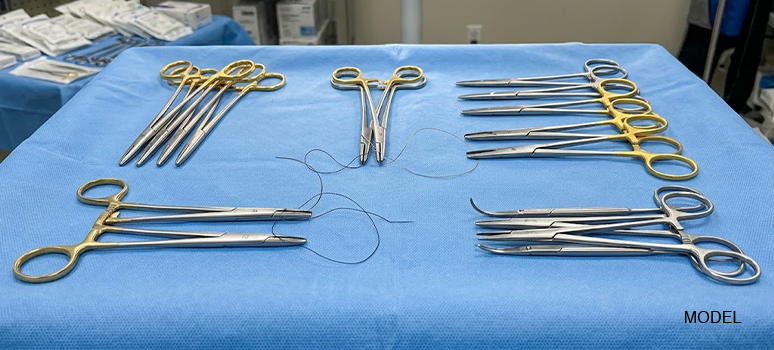
Tungsten carbide inserts can be incorporated into the jaws of a needle holder to improve wear resistance and gripping performance. Premium needle drivers may also use gold-colored finger rings to identify instruments featuring tungsten carbide inserts.
The advantage is especially relevant when instruments are used frequently.
Potential benefits include:
- Stronger needle engagement
- Improved resistance to jaw wear
- More consistent gripping performance
- Longer service life when properly maintained
- Better control during fine suturing
- Reduced need for frequent replacement
Robbins Instruments highlights tungsten carbide construction among its premium needle driver offerings, including models designed for professionals who require dependable performance during surgical closure.
Choosing the Right Needle Holder for Your Procedure
The best needle holder instrument depends heavily on the procedure.
There is no universal model that is ideal for every surgical application.
Mayo-Hegar Needle Holders
Mayo-Hegar needle holders are versatile instruments commonly associated with general suturing and soft-tissue procedures.
Their robust construction makes them suitable when a stronger grip is required.
Olsen-Hegar Needle Holders
Olsen-Hegar instruments combine a needle holder with integrated scissors.
This multifunctional design can reduce the need to switch between instruments during certain suturing tasks, potentially improving workflow.
Robbins Instruments’ product selection includes Mayo-Hegar and Olsen-Hegar needle holders.
Crile-Wood Needle Holders
Crile-Wood designs are often selected when greater precision is needed for smaller needles and finer suturing.
They can be useful in procedures where delicate needle control is particularly important.
Castroviejo Needle Holders
Castroviejo needle holders are associated with fine, precise suturing and microsurgical applications. Their spring-action design can provide a different handling experience from traditional ratchet-style instruments.
Webster Needle Holders
Webster needle holders are commonly associated with delicate suturing and are particularly useful when a smaller, lighter instrument is preferred.
The correct selection should always reflect the procedure, needle dimensions, tissue characteristics, and established clinical technique.
How Needle Holders Improve Suturing Control
Successful suturing requires more than simply holding a needle.
The operator must control the needle’s entry point, direction, rotation, and exit point while maintaining appropriate suture tension.
A dependable needle driver helps create a stable connection between the user’s hand and the needle.
This can support:
Consistent Needle Placement
A secure grip allows the user to guide the needle along the intended path.
Controlled Needle Rotation
Proper needle manipulation often requires rotating the needle through tissue rather than forcing it through tissue in an unnatural direction.
Reduced Slippage
A suitable jaw surface helps prevent unwanted needle movement during placement.
Improved Procedural Efficiency
When the instrument performs predictably, less time may be spent repositioning the needle or compensating for inadequate grip.
Better Handling During Fine Suturing
Small needles demand precise control. A needle holder that is appropriately sized for the task can make delicate work more manageable.
Robbins Instruments: Surgical Instruments Built Around Precision
When professionals search for needle holders near me, they need a supplier that understands the demands placed on surgical instruments.
Robbins Instruments has a long history in medical instrumentation. The company was founded in 1952 by Noel Robbins and has developed expertise in dermatology, cosmetic, reconstructive, and surgical instrumentation. Robbins Instruments and Liposales merged in 2021, creating a broader supplier of plastic and cosmetic surgery equipment and instruments.
Today, the Robbins Instruments catalog includes a range of surgical instruments, including needle holders, forceps, scissors, and other specialized tools. Its needle holder selection includes options such as Mayo-Hegar, Olsen-Hegar, Halsey, and Webster models.
For practices building or maintaining a surgical instrument tray, working with an established supplier can simplify the process of finding instruments suited to specific procedures.
Explore Surgical Needle Holders at Robbins Instruments
Common Mistakes When Selecting Needle Drivers
Choosing a needle holder based only on price is one common mistake.
Other issues include selecting an instrument that is too large for delicate suturing, using a fine instrument for needles that require greater holding strength, overlooking handle ergonomics, and failing to consider the frequency of use.
Another mistake is assuming that every needle holder performs identically.
Design differences can influence grip, control, durability, and user comfort. Comparing several models based on actual procedural requirements is therefore a better approach.
Why Durable Needle Holders Matter for Surgical Trays
A surgical tray is only as effective as the instruments it contains.
When a needle holder does not perform reliably, the problem can affect the entire suturing workflow. An instrument with consistent jaw engagement, smooth operation, and appropriate ergonomics provides a more dependable foundation for needle manipulation.
For facilities that perform frequent procedures, durability is equally important.
A high-quality instrument should be viewed as a long-term component of the surgical toolkit rather than a disposable purchase.
That makes durable needle holders near me a more useful search concept when paired with considerations such as construction, application, manufacturer quality, and instrument care.
FAQS
1. What should we look for when searching for needle holders near me?
We recommend comparing the instrument’s size, jaw design, material, handle ergonomics, ratchet mechanism, intended application, and manufacturer reputation. Availability and location are useful, but instrument quality and suitability should remain priorities.
2. Are needle holders and needle drivers the same thing?
Yes. Needle holder and needle driver are commonly used interchangeably to describe instruments designed to grasp and manipulate surgical needles during suturing.
3. What are tungsten carbide needle holders?
Tungsten carbide needle holders feature tungsten carbide inserts in the gripping surfaces of the jaws. These inserts can provide enhanced wear resistance and secure needle engagement compared with conventional stainless-steel gripping surfaces.
4. Which needle holder is best for delicate suturing?
The appropriate model depends on the procedure and needle being used. Fine designs such as Webster or Castroviejo needle holders may be appropriate for delicate applications, while other procedures may require Mayo-Hegar, Crile-Wood, or Olsen-Hegar designs.
5. Where can we find surgical needle holders?
Robbins Instruments offers a selection of surgical needle holders and needle drivers, including several designs intended for different suturing requirements. Professionals can review the available options and select instruments based on their clinical application and preferred specifications.
Conclusion: Find the Right Needle Holders for Confident Suturing
The search for needle holders near me should ultimately lead to more than a convenient supplier. It should lead to instruments that provide the grip, precision, durability, and handling characteristics required for dependable suturing.
From Mayo-Hegar and Olsen-Hegar designs to Webster, Crile-Wood, Castroviejo, and tungsten carbide needle holders, different instruments serve different clinical requirements. Selecting the appropriate model can help surgical professionals maintain better needle control and create a more efficient workflow.
For practices looking to strengthen their surgical instrument trays, Robbins Instruments provides a broad selection of surgical instruments designed around precision and dependable performance. By considering procedure type, needle size, instrument construction, ergonomics, and long-term durability, we can make more informed purchasing decisions and ensure that every tray contains the right tool for the job.
The right needle holder is not simply an instrument it is a precision tool that supports controlled, efficient suturing when accuracy matters most.